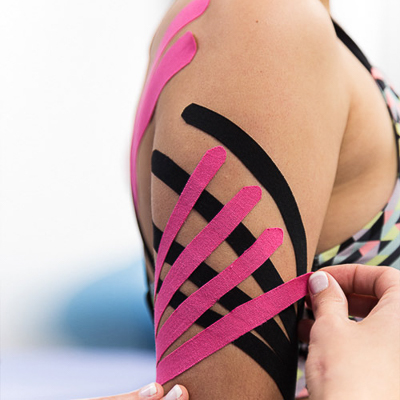
As an Advanced Sports Practitioner I am qualified to apply Kinesio taping, which I use for many sporting and non-sporting injuries – for example, “frozen shoulder”, back pain, rotator cuff injuries, “tennis elbow”, plantar fasciitis and achilles tendinopathy to name but a few.
Different to the historical taping methods; where joints may have been restricted, kinesio taping is cotton and flexible and allows full range of motion. Through elastic properties and quick recoil, tape can help distribute forces to other nearby areas through the fascia, ligaments, and even bones.
Taping is reported to reduce pain sensitivity of pain. When kinesiology tape is applied correctly it is reported to change how your body interprets pain, turning down the pain “volume” that your body hears. It is also reported to decompress the area of swelling and inflammation with microscopic lifting the skin and allows the “by-products created by inflammation to be removed more quickly” (as reported by Rock Tape UK).
The effects on muscle fatigue has been researched and has been shown that it can reduce the effect of fatigue and can normalise muscle tone – supporting inactive muscles and inhibit over active muscles, helping movement co-ordination.